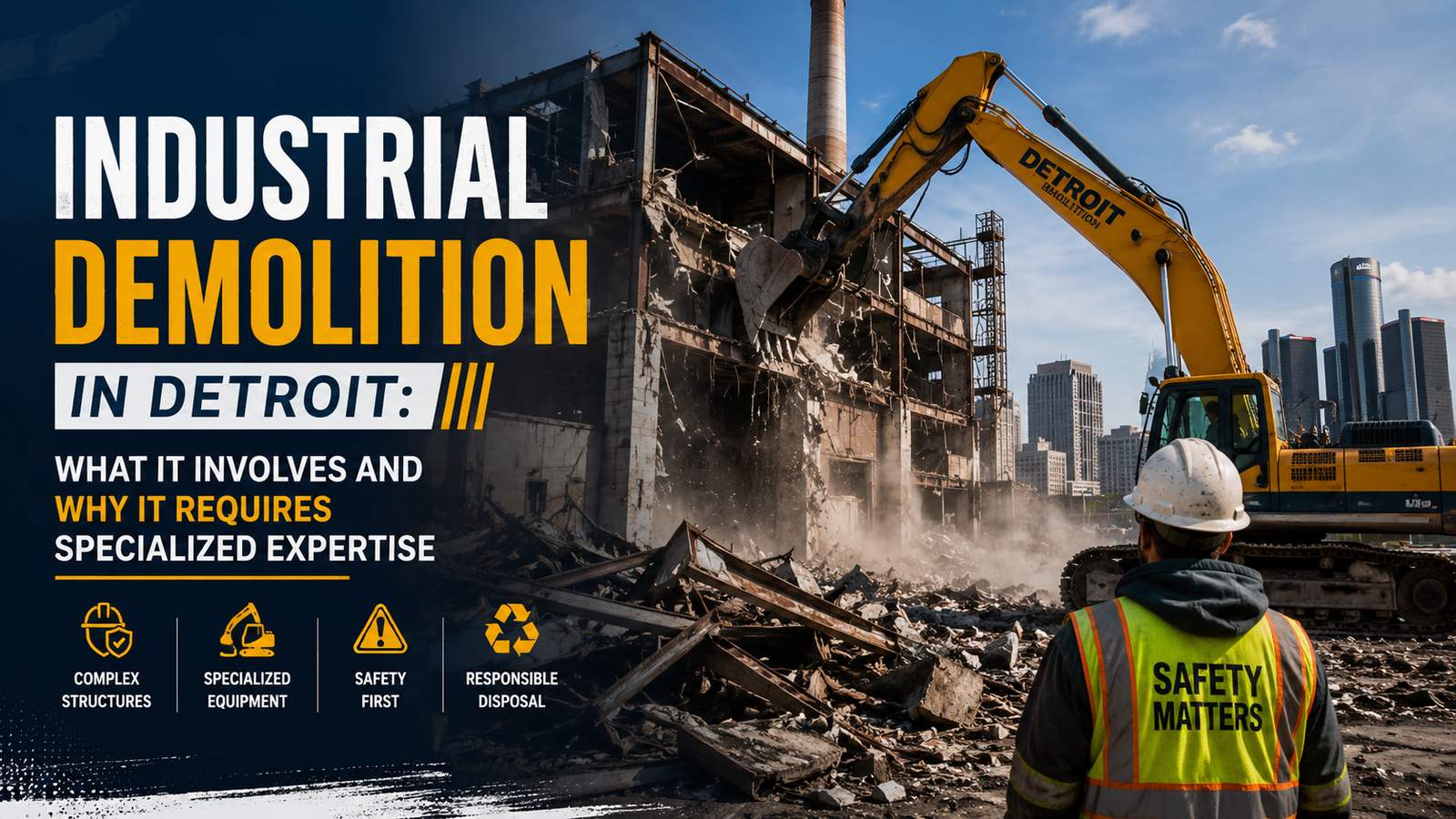
Detroit’s identity as the industrial heartland of America is inseparable from its built environment. The city and its surrounding region are home to a vast legacy of industrial structures manufacturing plants, stamping facilities, foundries, chemical processing facilities, warehouses, and distribution centers that defined the Motor City’s 20th-century economy. As industrial activity has shifted, consolidated, and modernized, many of these structures have been vacated, decommissioned, or slated for replacement. Industrial Demolition Detroit is the process of safely, efficiently, and responsibly removing these structures and it is among the most technically demanding categories of demolition work in the construction industry.
What Makes Industrial Demolition Different
Industrial demolition is categorically different from residential or light commercial demolition in terms of scale, structural complexity, hazardous material profiles, environmental requirements, and equipment demands. Industrial buildings in Detroit range from modest single-story manufacturing plants to massive multi-story complexes covering hundreds of thousands of square feet, with structural systems that may include heavy reinforced concrete frames, structural steel, masonry bearing walls, and specialized industrial construction like crane bays, pit structures, and process equipment foundations.
The hazardous material environment in industrial buildings reflects the activities that took place within them. Asbestos was used extensively in industrial construction for pipe insulation, boiler insulation, duct insulation, fireproofing, roofing, and flooring products. Lead-based paint coated structural steel and equipment throughout the era when these materials were standard. Additionally, industrial processes leave behind contamination profiles that residential structures do not PCBs (polychlorinated biphenyls) in electrical equipment, petroleum hydrocarbons from decades of manufacturing activity, heavy metals from plating and finishing operations, and process-specific chemical residues.
The combination of scale, structural complexity, and hazardous material density means that industrial demolition requires contractors with specialized expertise, equipment capacity, regulatory knowledge, and environmental compliance systems that go well beyond what is needed for residential or commercial projects.
Pre-Demolition Planning for Industrial Projects
Successful industrial demolition begins with thorough pre-demolition investigation and planning a phase that can span weeks or months for large, complex facilities. A comprehensive pre-demolition survey documents the building’s structural system, identifies all regulated materials (asbestos, lead, PCBs, and other substances), assesses environmental conditions, identifies utility infrastructure, and develops the framework for the demolition strategy.
Structural analysis is critical for industrial demolition. Engineers review original building drawings (if available), conduct field investigation of actual structural conditions, and assess how the building will behave during demolition. Industrial structures often have unusual structural configurations crane rails, suspended monorail systems, large-span roof structures, and underground pit and trench systems that require specific demolition sequencing to manage safely.
Hazardous material abatement must precede structural demolition. For large industrial facilities, this abatement scope can be enormous hundreds of thousands of linear feet of pipe insulation, large quantities of fireproofing on structural steel, industrial floor tiles, PCB-containing electrical equipment that must be specially handled and disposed of. The abatement work often takes longer than the subsequent structural demolition, and managing it efficiently requires experienced environmental contractors working from a comprehensive abatement specification developed during the pre-demolition survey.
Regulatory coordination for industrial demolition in Michigan involves multiple agencies. The Michigan Department of Environment, Great Lakes, and Energy (EGLE) oversees environmental compliance. MIOSHA (Michigan Occupational Safety and Health Administration) governs worker safety requirements. Local building and fire departments have their own permit requirements. For very large projects or those involving significant environmental contamination, the EPA may also have oversight interest. Professional industrial demolition contractors manage these regulatory interfaces as part of their project management scope.
Demolition Methods for Industrial Structures in Detroit
The method of demolition for an industrial structure is selected based on the building’s structural system, its surroundings, and the end-use plans for the site. Mechanical demolition using large excavators often in the 50-to-100-ton class or larger is the most common approach for Detroit industrial buildings. High-reach excavators with long booms can reach the upper floors of multi-story structures, using demolition shear or grapple attachments to pull, cut, and break structural elements systematically from the top down.
Selective industrial demolition is sometimes required when portions of a large complex are to be preserved while others are removed. This requires careful structural analysis to ensure that the demolition of removed sections does not destabilize retained sections. Temporary structural support systems may be required to maintain stability during the transition.
Implosion the controlled use of explosives to collapse a large structure is occasionally used for industrial demolition in Michigan when structural and site conditions make it the most efficient approach. Implosion requires specialized expertise from licensed explosive contractors, extensive pre-demolition preparation including weakening key structural elements, comprehensive dust and debris control planning, and rigorous coordination with local authorities and utilities. It is a relatively rare technique used for specific situations rather than a general-purpose approach.
Detroit’s Industrial Demolition History and Context
Detroit has been at the center of large-scale industrial demolition for decades. The departure and consolidation of automotive manufacturing and its supplier base from the Detroit region has left behind an extraordinary inventory of industrial buildings requiring demolition, remediation, and redevelopment. Projects ranging from the clearance of former stamping plants to the demolition of entire industrial complexes have been carried out across Detroit and surrounding communities.
The redevelopment of former industrial sites brownfield redevelopment is a major driver of industrial demolition in Detroit. Brownfield sites (properties with known or suspected environmental contamination from prior industrial use) require the combination of environmental remediation and structural demolition to transform them from industrial liabilities into developable assets. Michigan has an active brownfield redevelopment program that provides tax increment financing and other incentives for qualifying brownfield projects, which has helped support the economics of industrial demolition and redevelopment across the state.
Frequently Asked Questions About Industrial Demolition in Detroit
How long does industrial demolition take? Project duration varies enormously depending on facility size and complexity. A small single-story industrial building might be demolished in a few days. A large multi-story complex might require months of abatement followed by months of structural demolition. Large projects are often phased, with sections cleared progressively to allow redevelopment to begin while demolition continues elsewhere on the site.
What environmental testing is typically required for industrial demolition? The scope of environmental testing depends on the facility’s history. All regulated materials (asbestos, lead, PCBs) require pre-demolition survey and testing. Sites with industrial process history may require Phase I and Phase II Environmental Site Assessments (ESAs) to characterize soil and groundwater contamination. These assessments inform remediation requirements and protect all parties from unexpected contamination liabilities.
What happens to the material from an industrial demolition? Structural steel is recycled as scrap the scrap value of steel from large industrial demolitions can offset a significant portion of demolition costs, making structural steel a positive economic asset in the demolition equation. Concrete is crushed and recycled as aggregate. Abated hazardous materials are disposed of at licensed hazardous waste facilities. General demolition debris goes to permitted disposal facilities.